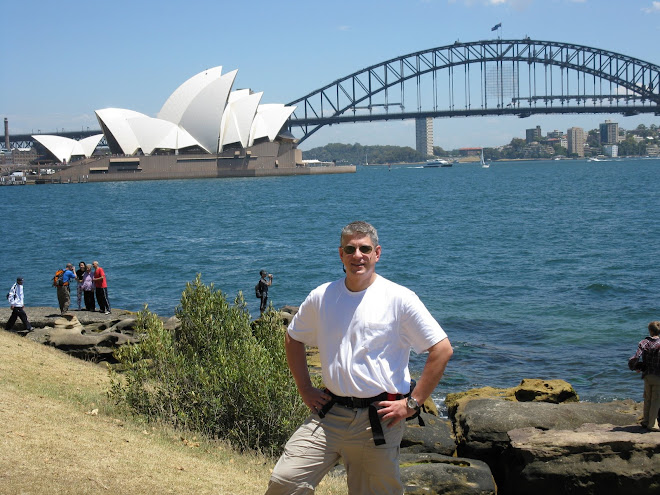
Scenes from the first day in Sydney

Scenes from the first day in Sydney
D, the Opera House, and the Bridge

Sunday, July 5, 2009

And He Could Do No Miracles for their Lack of Faith

Yesterday we arrived in Port Pirie, our third rural city on this five city roadshow doing parish missions on Ignatian Spirituality. Hopefully, I will have wireless access by the end of the week, and will be able to post some of the digital photos from our experience diving with dolphins and giant cuttlefish. For now, the homily from this Sunday.

Mark 6:1-6

He left that place and came to his hometown, and his disciples followed him. 2On the sabbath he began to teach in the synagogue, and many who heard him were astounded. They said, “Where did this man get all this? What is this wisdom that has been given to him? What deeds of power are being done by his hands! 3Is not this the carpenter, the son of Mary and brother of James and Joses and Judas and Simon, and are not his sisters here with us?” And they took offense at him. 4Then Jesus said to them, “Prophets are not without honor, except in their hometown, and among their own kin, and in their own house.” 5And he could do no deed of power there, except that he laid his hands on a few sick people and cured them. 6And he was amazed at their unbelief.

Then he went about among the villages teaching.


There was a Thomas Wolfe novel by the name of "You Can't Go Home Again" about an author who writes a book that reveals a few too many truths about his hometown. While the book is very popular and highly acclaimed elsewhere in the country, people from his past make it very clear he is not welcome to return home again. Today in our Gospel, Jesus gets a taste of this inhospitality himself.

While he has already begun his ministry and developed a reputation abroad for the wisdom and authority of his teaching, and for the power he demonstrates in and through miracles of healing, he has a very different reception on his return to Nazareth. Nazareth was probably a very small town, no more than a 1000 people, and very likely most of them were inter-related. It was a very tight knit community, and its population had a reputation in the region for being a bit backward in its thinking.

You probably know that one of the beautiful things about being from a small town is that everybody knows you. They know your family, they know your business, and people look out for each other. You can walk down the street and say hello to people by name. There is a sense of being part of a community, and as you know here in Port Pirie, that is a very fine thing.

But every light casts a shadow, doesn't it?

You probably also know that the downside of living in a small town is that everybody knows you... or at least they presume to. People presume that in knowing who you are, what kind of family you come from, and what you do, they have sized you up-- measured your character and your quality. This kind of knowledge can be a sort of power. Do you know what I am talking about when I say that knowledge can be power?

We can use our presumed knowledge for two purposes in particular. We use it to define and label people, assessing who's in and who's out, or who is considered a good bloke and who is a black sheep. We can cage people with our expectations of them and keep them in that box their whole lives.

We can use our presumed knowledge to keep people in their place, keep them from becoming too big for their britches. Here in Australia, you call this the peril of the "tall poppy," so that if a person really is talented or excells, they better not shine too bright otherwise they will get cut down to size. We can also control people's reputation through our gossip, sinking people with a single rumor.

Do you know what I am talking about? Why do you think we do this?

If I am not mistaken, the reason we do this is that we are a bit ambivalent about being known. On one hand, it is nice to be really familiar with people, part of a big family that looks out for its own. On the other, there is a kind of vulnerability it being known that is hard because we can feel more vulnerable to judgments and attacks. So, we can at times use our presumed knowledge of others as a defense. Does this make sense?

This can make it very hard for gifted people to remain, or for young people to develop their skills and abilities in such a way that they can find appreciation and appropriate acclaim. In this way, tightly knit communities can enforce a kind of safe mediocrity on themselves, protecting themselves from threats or surprises.

Jesus himself is not immune to this experience. How it must have pained him to return to this hostile reception. It isn't so much that his own townspeople don't welcome him. They will welcome him so long as he is willing to play the role assigned to him-- the carpenter, the one people still gossip about because he was born nearly out of wedlock under mysterious circumstances. There is no way this one could be as special as his reputation says he is. Where could he have learned all that he is saying?

What lesson can we draw from this? It seems that we are being invited to refrain from presuming that we know others so well that they cannot grow, change, and perhaps surprise us. And most of all, perhaps we have to avoid presuming to know how God works in our lives. Maybe it is most important that we avoid putting God in a box and instead allowing God the room to surprise us, perhaps even work a miracle.

Thursday, June 25, 2009

Self-Care for Caregivers


Self-Care for Caregivers… What? Why? How?

By Rev. David C. McCallum, S.J.

Based on the work of Grissel Hernandez, MPH, BSN, RN, HN-BC, CCE (2009) The Art of self-C.A.R.I.N.G. on ADVANCE for Nurses and the spirituality of St. Ignatius of Loyola.


We begin with what it is we desire to become…

Example:

“How do I become a more mindful, compassionate presence in the world?”

Remember:
· I cannot give what I do not have
· Love is a renewable resource
· God is the source of Love and our lives are a response to Love

So, we develop practices to help us connect more consciously to God, the Source of caring and compassion.

C.A.R.I.N.G.—5 Interconnected Practices

C-ompassion
A-wareness
R-eflection
I-intention
G-ratitude


Compassion

What is it? Compassion is the willingness to feel with and for another, even to the point of suffering. It is a form of love that is based on a relational sense of being interconnected, and it can be a powerful motive for action on behalf of others.

Why is it important for us? Compassion helps us to be kind, tender, and forgiving toward ourselves, which in turn helps us be kind, tender, and forgiving toward others. It helps us be patient with our own weaknesses and shortcomings, tolerant of imperfections, and willing to accept ourselves as we are.

How do we practice it? Once a day, we might simply take some time to pay attention to ourselves in Three Dimensions (3D) of our experience: body (How are we feeling physically?); mind (What thoughts are occupying our attention?); spirit (How are we feeling emotionally?). In paying attention to ourselves in this way, we want to maintain an attitude of compassionate self-regard. Another way is to do a visualization exercise, seeing ourselves the way that God sees us, allowing God’s love to flow into and through us toward others.

Awareness

What is it? Awareness is a state of being conscious of both our internal state of mind and heart as well as of what is going on around us.

Why is it important? It allows us to be fully present to our moment to moment experience, as well as to give others our full attention. Awareness is the means through which we center ourselves emotionally, and through which we ground ourselves in our sense of purpose and value.

How do we practice it? Conscious attention to our breath is a helpful anchor for our mindful awareness in the present moment. We can cultivate this attention to our breath by spending 15 – 20 minutes each day doing Mindfulness Meditation, and by bringing our attention back to our breath whenever we feel our attention fragmented by anxiety or distraction. This breathing awareness brings balance and groundedness to our thinking, feeling, and doing.

Reflection

What is it? Reflection is simply thinking about our experience with a spirit of inquiry and openness to insights and learning from that experience.

Why is it important? Through reflection on our daily experience, we develop a sense of what is important to us, and an “inner compass” that helps us make decisions in our life. Furthermore, with reflection, we learn from our mistakes and develop our intuition, and practical wisdom.

How do we practice it? Through our use of mindfulness meditation, and a daily exercise like the Ignatian Examen of Consciousness, we nurture this capacity to pay attention to our experience. In the Examen, inquire into what we are thinking, feeling, and doing. We explore our motivations, our patterns of behaviour, our attachments and addictions.

Intentionality

What is it? Intentionality is the mindful focus of our energy on the achievement of a goal or the pursuit of a purpose.

Why is it important? By consciously setting an intention, we put forth a purpose or end toward which we strive, and by which we align our energy (thoughts/attitudes, behaviours, evaluation of the outcomes). The higher our intention, the more likely we are to discover meaning and value in life, including the challenges and set-backs. When we pursue a sacred intention, as Jesus did, we are better prepared for the inevitable sacrifices that we must make along the way.

How do we practice it? Every day, upon waking, we might begin the day by setting our intention and asking God to help us to fulfill our purpose. Examples include St. Francis of Assisi’s prayer, “Lord, make me a channel of your peace,” or St. Ignatius of Loyola’s prayer, “Lord, I pray that all my thoughts, feelings, and actions are in harmony with your most holy will.”

Nonjudgmental

What is it? Nonjudgmental attachment is a form of loving acceptance of reality as it is. Acceptance means being aware of your experience without either clinging to it or resisting it. Instead, it is to accept your reality in the moment with a peaceful composure.

Why is it important? Despite the way we might want to attach ourselves to things and people we are attracted to, or resist and push away things that repulse us, or change things that do not conform to our desires, reality will often resist us unless we come from a peaceful, detached place in ourselves. Reality is a powerful teacher in that it seldom conforms to our ego’s preferences. So, developing a grounded and emotionally centered detachment helps us better assess situations before we act.

How do we practice it? Rather than reacting to circumstances and being compelled by the emotions stirred up, I become a detached observer of my experience. This practice of observing myself can help me develop a sense of patient calmness and help me to make decisions with greater clarity. It is also helpful to return to the present moment when our attention drifts to what has just happened, or to what may happen.

Gratitude

What is it? It is both a feeling of appreciation and an attitude of thankfulness.

Why is it important? Our attention is naturally attracted to the negative experiences in our lives, but we have to practice paying attention to the positive. Gratitude fosters a sense of joy, security, and abundance. It connects us to God, the giver of all gifts, and inspires our generosity. It also helps us keep perspective when we tend to be “givers,” reminding us of the importance of receiving graciously from others.

How do we practice it? One of the easiest ways of cultivating gratitude is to use the Ignatian Examen of Consciousness on a daily basis, rummaging and combing through our day for all the events, relationships, and feelings that we have been privileged to experience. Teilhard de Chardin once suggested that we are not human beings who have spiritual experiences, but spiritual beings having human experiences.

And another thing…

While each of these five practices is an asset for becoming a more self-caring care-giver, one more is indispensible for keeping our perspective, being grounded, and most importantly, for remembering that we are human beings, not God. When we are able to laugh at ourselves and see the humor, irony, and at times even the absurdity of life, we can avoid becoming cynical or giving up. So for all the seriousness of these ideas and the importance of these practices of self-care, perhaps most importantly—laugh often!

One last word: “No”
The intention behind all of these practices is not to turn us into superwomen and men, but rather, to be more fully human in our way of living and loving. We may occasionally fall into the temptation to try to do more Jesus himself did in the service of others, but part of being human is knowing and respecting our limits. This means that we must be kind enough to ourselves to discern where, when, and how to use the “n” word… “no.” Sometimes we must grow into the freedom to say “no” appropriately. This requires the self-knowledge and freedom from fear… freedom from the need to please; freedom from the need to be perfect; freedom from the need to help everyone; freedom for the need to always have our acts together. It is a kind of spiritual hubris to think that we can do otherwise.

Wednesday, June 17, 2009

Road Trip!

So, it looks like you'll get a rest from this particular blogger for the next five weeks or so, until the end of July. I'll be taking to the road giving parish missions/retreats in South Australia, and I'm more than a little doubtful that I'll have wireless in the "bush" as they say here in Oz. So, peace and all good things! See you at the end of July.

Some Thoughts about the Spirit With Which We Serve Others

JESUS: EXEMPLAR OF LOVING SERVICE
By Rev. David C. McCallum, S.J.

How can we stay “out of the way” and allow God to be the agent of grace and healing through us? Jesus provides the example.

➢ Ego driven service relies exclusively on my human effort, whereas Jesus’ service flows out of a relationship with God. I need to listen to the promptings of God and lean on God’s strength to accomplish the task. Can I appreciate the difference? What happens when I try to do everything myself? Or, on the other hand, when I have no confidence in my abilities? What is different about my experience of service when I am depending on God, when I act as a channel, allowing God to be the source of my love, my patience?

➢ Ego driven service is impressed with the “show” whereas Jesus’ service is contented in hiddenness, in the intrinsic worth of what he does for others. Here I might recall all the times when Jesus tells people to keep quiet about what he has done for them. I might try to avoid doing things for others as a means of getting applause or reward, relying instead on God’s affirmation. Am I free enough from my own interior needs that I can serve others without expectations of reward, or even gratitude? What sorts of feelings and thoughts come up for me as I ponder this? At the same time, if I am afraid of being in the spotlight at all, how might I learn to be gracious in receiving recognition, or expressions of gratitude?

➢ Ego driven service is calculated, and concerned with results, whereas Jesus’ service surrenders the outcomes in a disposition of faith. I need to let go of my expectations and not be disappointed when my service seems ineffective. In every so-called failure there is instruction and even grace. Am I overly goal oriented, so much so that I am frustrated when I do not achieve what I set out to do and unable to appreciate what actually happens? What might I need to let go of here? I might consider the events of the passion, and how this seemed to be a total defeat for Jesus. What advantage is there in working hard and at the same time, surrendering the outcomes? At the same time, if I find it hard to believe in myself and my own plans or designs, how can I grow in a realistic belief in my ability to follow through with my goals?

➢ Ego driven service picks and chooses whom to serve, whereas Jesus modeled a radical availability to any persons who present their needs. It is so easy to favor those who are rich and powerful, those who can repay me with advantages and benefits. It is so hard to make a preferential option for those who are poor and weak. How do I feel about giving of myself to people who might not be able to benefit me in a way that the world would judge valuable? On the other hand, what blessings have I received from my interactions with those who are weak, poor, and seemingly unable to help themselves? Sometimes our solidarity with the poor comes with the price of feeling animosity toward those of means. Is it possible to pray for a compassionate heart for both the weak and the wealthy?


➢ Ego driven service is subject to the vicissitudes of my feelings and moods. Jesus seems to be profoundly sensitive to others and aware of his own feelings, manifesting every emotion we might expect. At the same time, his loving service does not seem to depend on his like or dislike for people, nor on his own mood. In fact, he is able to keep his focus on others even when he is suffering himself. What would allow me to find joy even when there is no cause for happiness? Can I be in touch with my feelings without my attitude, choices, and actions being entirely dictated by them? What resources or practices provide me objectivity about my own experience? Or perhaps I have never been able to trust in my own instincts and feelings, and it is time to believe in the authority of my own experience?

➢ Ego driven service is inconstant and a matter of our convenience. Service inspired by Jesus’ example is an ongoing commitment, a way of life. What is my attitude toward time, and my willingness to put others before my schedule, my plans, my timeline? Are there ways that I need to become more flexible and generous? At the same time, If I am always over extended, are there ways I need to be more careful about respecting my limits? Personal balance is very important to my capacity to serve others over the long-term, as much as I want to be generous on any given day. Do I struggle with a compulsive need to be needed? Where does this stem from?

➢ Ego driven service is driven by what I think is best for others. True service involves such sensitivity that I allow others to tell me what they need. Can I allow others to take the lead without sacrificing important boundaries? To what extent do I need to trust God and others? Do I have a strong need for control? Where does this come from? At the same time, there are times when I must trust my instincts, and intervene on behalf of those who cannot help themselves. Do I trust too much or too little in my own inner voice?

➢ Ego driven service enforces a separation between me and the people I serve. Jesus’ example of service builds community and helps us discover that in relation to others, there are more similarities between us than differences. Am I open to being in relationship with the people I serve, or do I use my role as a means of maintaining “safe distance” from others? Is there a way of being with people that also allows me to do my job? Is there a way of maintaining my integrity while at the same time being appropriately vulnerable with others? Or perhaps I find that I do not have very good boundaries, and am easily exploited by other people’s needs, or that I get overly caught up in other people’s problems in ways that are not healthy. How might I work on drawing more healthy boundaries and set appropriate limits in other people’s expectations of me?

Tuesday, June 16, 2009

Making a Difference in the World

Over the past few days, I've had the privilege of being a sounding board for two friends, each of them considering ways that they'd like to make a real qualitative difference in the world. One of them is hoping to develop and test a model for societal level change in a small, war-ravaged developing country. The other is developing a model for a training program that aims at helping leaders lead from a much more spiritual, purpose-led place, with the hope that this program might eventually spread internationally. I am grateful to be able to listen to them as they explore the intersections between their passions, priorities, and the needs of the world as they see them.

Listening to the two of them prompts me to think of many things... the matter of how people discover their vocations; the ways in which we are prompted to make a difference in the world; the motives which drive us; and the challenge of finding a sustainable if simple livelihood in meaningful and service oriented work.

For my own part, I have seen how challenging it is to untangle my ego from my desires to influence the world in a positive manner, though each day I do try to keep an eye on my shadow, and stay out of God's way to the best of my abilities. I feel committed to this practice because I see how we tend to work, unwittingly, at cross purposes with our intentions. Consider, for example, how the intention of so many modern conveniences is to save us time so that we can spend more time at leisure activities. Does anyone see any evidence that the use of technology has brought us more time, or leisure, let alone happiness? Most people would say that we're working harder and longer hours than ever. Or the defense industry... some people rationalize that the purpose of the arms industry is to make us safer (whoever "us" is!); but the reality is that we've rarely been more insecure, despite the trillions we spend on "defense." Do you get my drift? Who profits from these myths?

So often, in an effort to solve problems we use the very same kind of logic/thinking that created them in the first place... leading to even more complex issues. And for the most part, this logic/way of thinking is largely ego driven, even very subtly. By this I mean that we are constantly using our individual and collective resources to compete with others, to establish and maintain our reputations, to defend ourselves against attacks, to accrue more material security, to pursue status and celebrity... or am I deluded? As a result, we continue to reproduce a sort of insanity... in our consumerism, in our obsession with national security, in keeping outsiders at a distance.

I must say, as I reflect on these matters, I cannot help but think we are desperate for a widespread spiritual awakening... not in the sense that we need to all suddenly "get religion," but rather, we need to wake up from the insanity that is currently driving the way the world works (and some of that insanity is religious in nature, is it not?).

Monday, June 15, 2009

Sunday Adventure: Watson's Bay to Bondi Beach


Despite the rain yesterday, Bruno (a Jesuit from the Swiss Province) and I walked six miles from Watson's Bay to Bondi Beach. As the Irish say, "it was a soft day." Above is one the many lighthouses along the way, much needed because of the number of storms that have wrecked ships off the coast over the years.

Bruno and me at the beach. Isn't it strange how small the sailboat looks out there? The perspective doesn't seem quite right.


This is a close up of one of the beautiful larikeets enjoying the nectar of the local flora.


In between the raindrops, a scene of the coastline.


This is Sydney Harbour, the city, and the harbor bridge in the distance from a park near Bondi. Tomorrow, some reflections on a meeting I had with a friend who does organizational development work here and internationally.

Sunday, June 14, 2009

The Body and Blood of Christ

Today is the Feast of the Body and Blood of Christ, formerly known as Corpus Christi Sunday. Below is more or less the homily I preach for the community here at Canisius College.

To begin with, I invite you to have in mind the string of a musical instrument, especially the way that it requires being held in tension in order to produce a rich, resonant, and beautiful sound. Without this tension, the tune is lost and the string produces no music. This past week in our tertian studies, we reflected on how the life of a Christian is to live in creative tensions, for instance:

between contemplation & action

between being People of the world/citizens of nations & People of the Gospel

between Body & Spirit

between being simultaneously Sinners & Beloved by God

Why do I mention this? Because our Celebration of the Body and Blood of Christ calls for us to hold such tensions if we are to deepen our appreciation for the gift God gives to us in the Eucharist, in which God communicates his very self to us.

One side of the tension is that which is described in the reading from Exodus, where God establishes a covenant with Moses, the covenant of the law. The law is a gift to the Israelites intended to save them from the chaos of sin, and to establish them as a special people. The law was intended, not as a burden, but as a blessing.

The Eucharist does not negate this first covenant… it includes it. In the Eucharistic prayer, wherever we hear the mention of sacrifice, and the offering of Jesus’ life as a means of saving us from sin, this first covenant is referenced… the covenant that Moses celebrated by showering the people with the blood of the sacrificial offerings… the blood a symbol of life.

But there is also a second covenant that includes and transcends the first… because even though the law was a blessing and marked the Israelites as a people special to God, God was not content living at a distance from people’s hearts, from the human experience. In this second covenany we discover that God desires not sacrifice, but justice and right relationship with our brothers and sisters; God does not desire us to live in fear of him so much as God desires us to live with a passionate and felt sense of God’s affection for us.

The second covenant, the one that Jesus establishes as the new Moses, is intended to liberate us from the fear of God, and to draw us into an intimate and loving relationship… God is Abba, Father… or even better, Dad… and we are the beloved children who share the inheritance that Jesus promises, the Kingdom.

So, the Eucharist includes within it two covenants… one about the law, and the other, a relationship of love.

That’s one of the creative tensions.

Can you handle another?

The second tension involves a little imagination on our part… I want to invite you to remember for a few moments a memorable meal… and as Ignatius recommends in his instructions on prayer… to use our interior senses to really savor the whole experience… Recall a memorable meal.

Was any body alone, raise your hand? I didn't think so. (Believe it or not, but evolutionary biologists have discovered that we're predisposed to enjoy a meal more in the company of others.)

The reason we recall these memorable meals was about more than the most sumptuous feast. While we might have paid plenty of attention to the delectable food, we probably spent our time in conversation… For my part, I remembered a meal when I was in Mildura on my last assignment giving the Retreat in Daily Life. It will undoubtedly be one of the most memorable experiences I have here in Australia. I was visiting with the families of two Italian women, sisters who made the retreat. We spent hours cooking together… an amazing meal! And then as you might imagine, there was laughter, and there were tears, and the sense of fullness was not only that of our bellies, but also out hearts…

In such a meal, there is an amazing chemistry that happens where nothing is missing, and the least thing taken away makes a difference… a single person missing would change everything. It is a chemistry that makes the ordinary into the extraordinary, that makes the mundane into the memorable.

So the other tension is this… Like the memorable meal, the Eucharist is not just the food that only God can provide, the Living Bread and the Saving Cup… is also an action and a matter of relationships.

The Real Presence, the Sacrament of our Incarnate God calls our attention likewise to the sacredness of the person sitting beside us, or the person huddled under a bridge for shelter, or the person sitting alone with no one to visit them, or to the Aboriginal child sitting in despair in a rural camp.

It is a mysterious and transforming chemistry of relationships… the Holy Trinity and each of us, the world of spirit and the world of matter, all made holy.

This bread that only God can give… Jesus Christ, who is taken, blessed, broken, and given for us and the life of the world—transforms us when we receive it and live in relationship with him and the world made new.

St. Augustine once wrote:

"I thought I heard your voice from on high: 'I am the food of grown men and women; grow then, and you will feed on me. Nor will you, as with bodily food, change me into yourself, but you will be changed into me.'"